Gantt
Overview
The Timeline screen allows you to view your schedule in a Gantt chart format easily. It enables you to track progress, understand dependencies, and focus on the critical aspects of your plan, all from a single, interactive view.
The screen allows you to:
- See the Gantt chart of your schedule
- Quickly assess progress across WBS/ACS levels and activities
- Spot critical path activities at a glance
- Easily filter your data.
- See the activities relationships
- See an Activity, WBS, ACS, or milestone info in one click
- View the Gantt of the critical path in isolation
- Trace the path leading to any specific activity
- Collaborate with your team by adding comments directly on activities
Explaining the screen
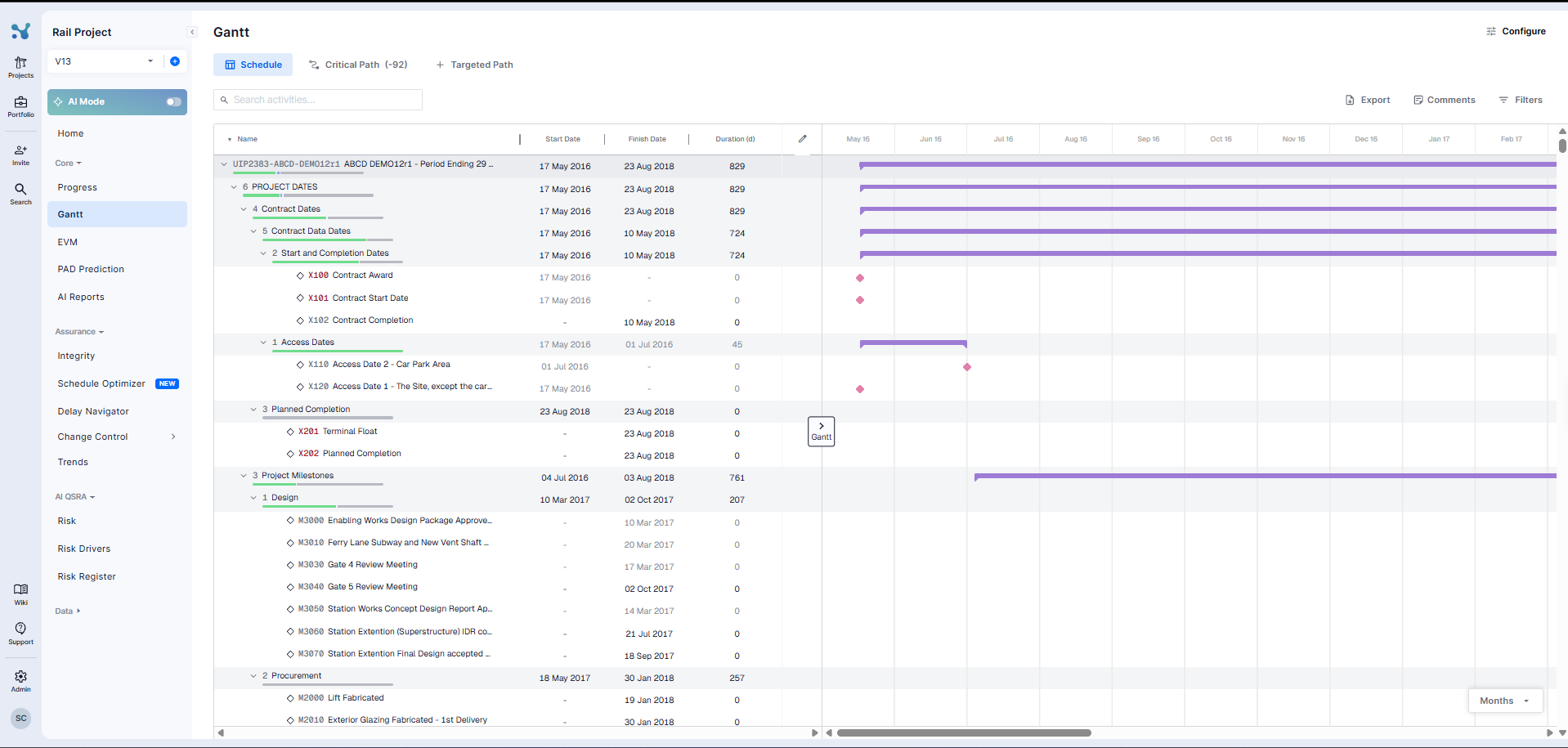
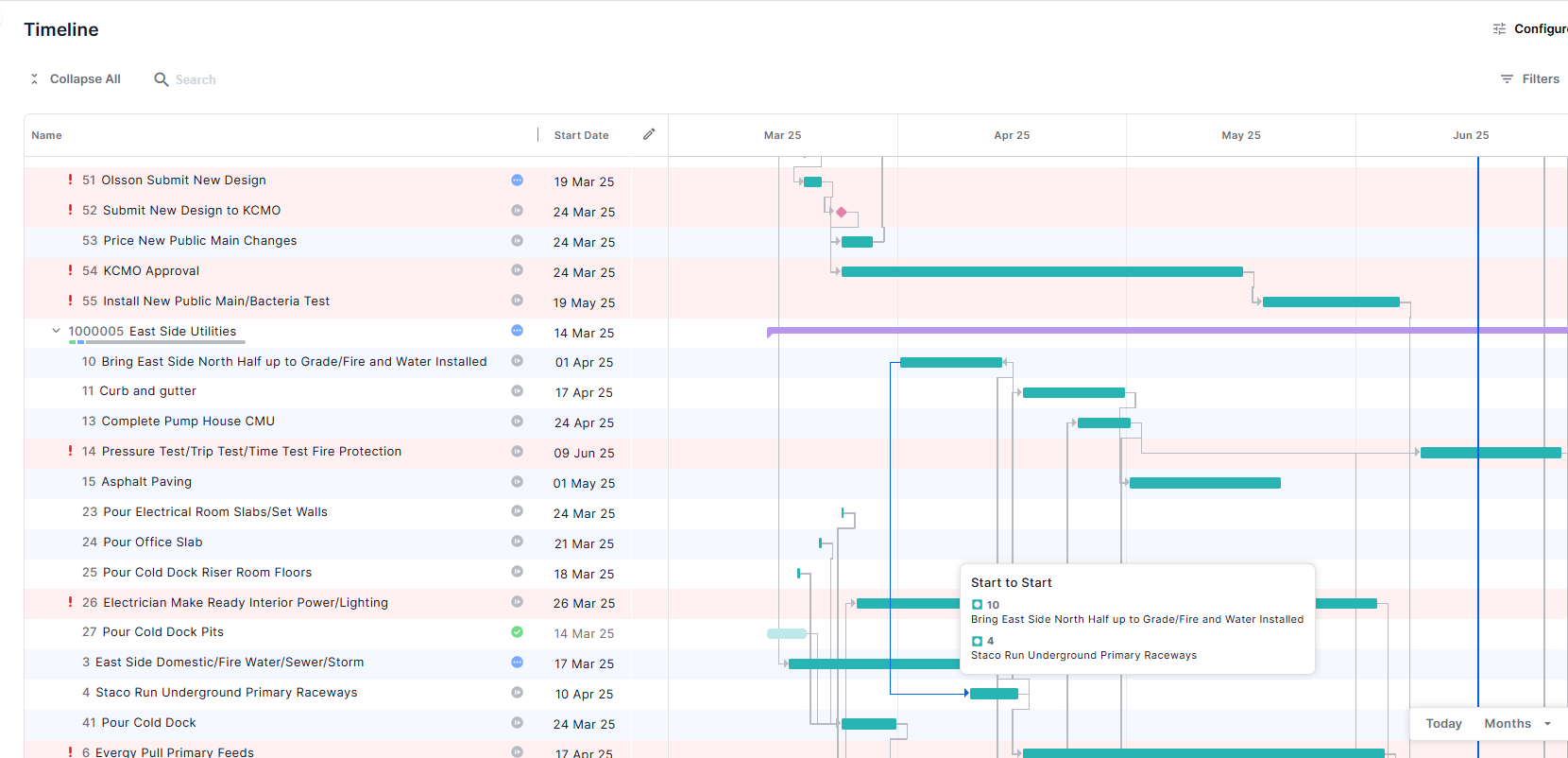
The Timeline screen displays your project schedule with a table and a Gantt timeline. Bars represent WBS and activities, diamonds represent milestones, and dependencies are shown with connecting arrows. The screen has three tabs at the top — Schedule, Critical Path, and Custom Path — each offering a different view of the schedule.
Progress Bars under the WBS
Each WBS row contains a progress bar segmented by activity status colors:
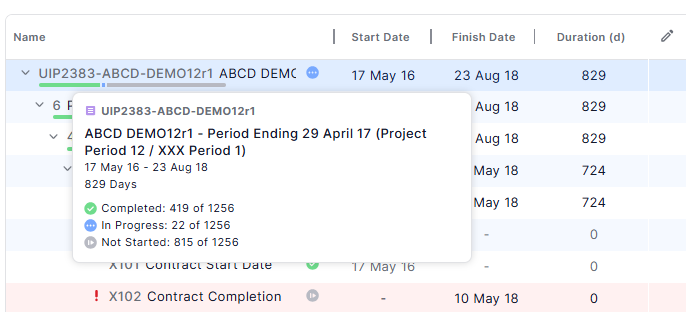
- Green indicates completed activities.
- Blue indicates activities currently in progress.
- Grey indicates activities that have not started yet.
Hover over the progress bar to see counts for each status category. This visual indicator helps you quickly understand progress at a glance for each WBS and its activities.
Group the Timeline by Activity Codes (ACS)
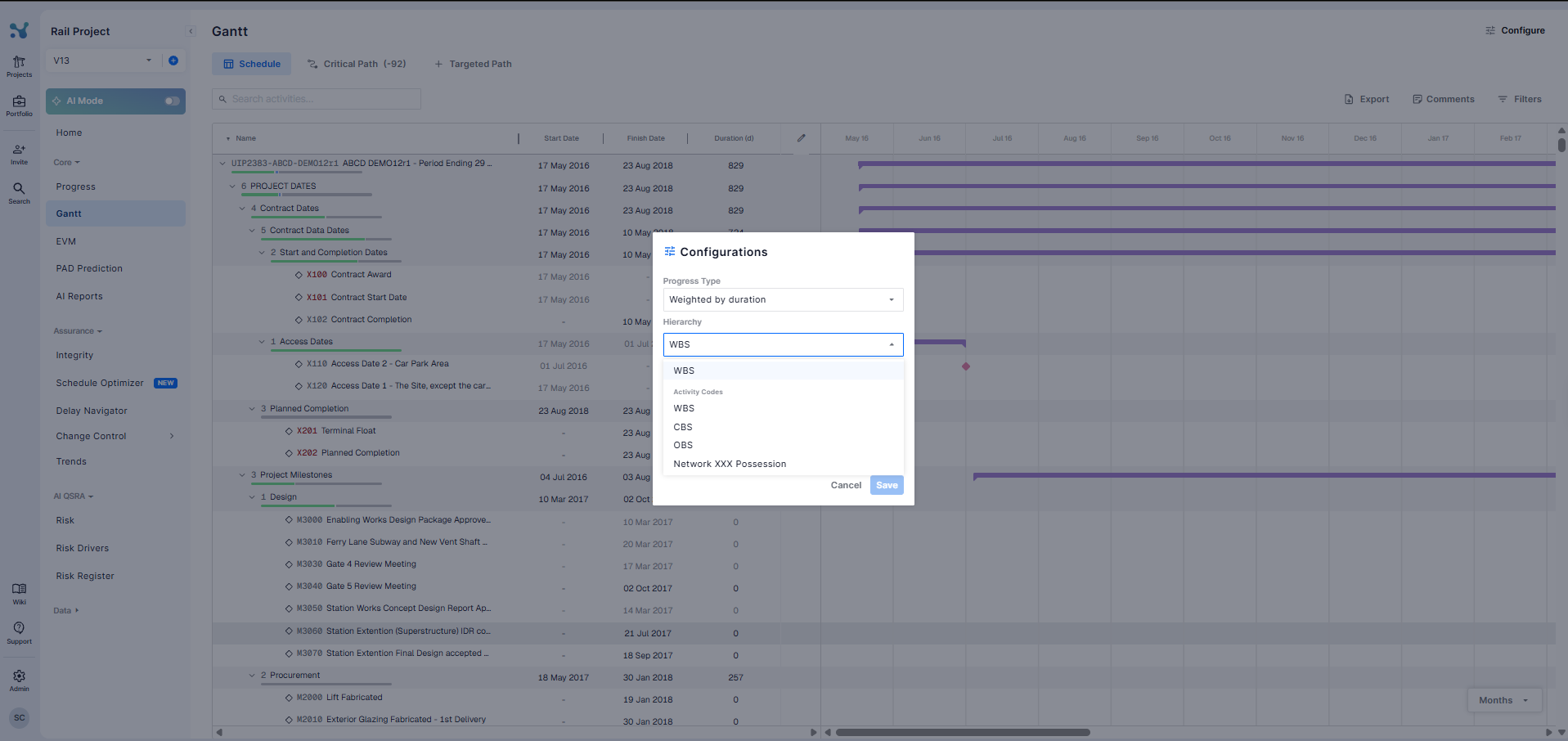
In addition to grouping activities by WBS, you can group the Timeline table and Gantt by an Activity Code Structure (ACS). This re-organizes both the table hierarchy and the Gantt bars around the code.
- Open the Configure pop-up from the top right corner of the Timeline screen.
- Under Hierarchy, open the hierarchy dropdown
- Select an activity code to group by
- Click Save
- Groups can be expanded/collapsed the same way WBS levels are, and progress bars, filters, and activity drawers behave the same as in WBS view.
Spot critical path activities at a glance
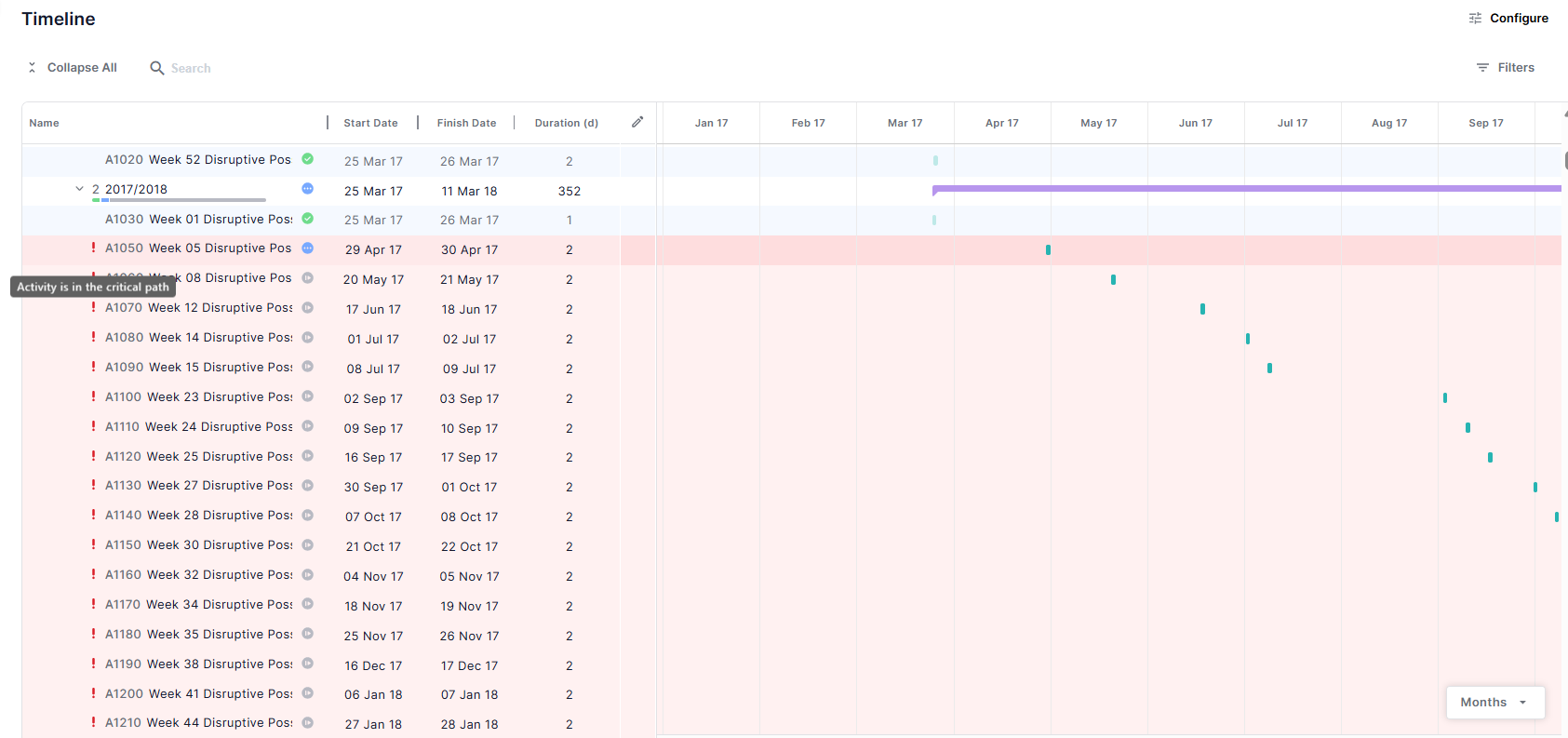
Critical path activities are marked in the table with a red background and an exclamation mark next to their name. This visual cue helps you quickly identify the tasks that directly impact your project’s finish date.
View the Critical Path Gantt
The Timeline screen includes a dedicated Critical Path tab next to the Schedule tab. Clicking it filters the Gantt to show only the critical path activities, with their bars highlighted in blue. The tab label shows the total float value . Hovering over the tab shows a summary of the number of critical activities and the float. Clicking any activity in this view opens the activity drawer.
Trace the path to a specific activity
The Custom Path tab lets you visualise the full sequence of activities leading up to any specific activity in your schedule.
To open a custom path:
1. Click the + Custom Path tab in the Timeline header.
2. In the Select Path dialog, choose a Target Activity (required). You can search by name or ID.
3. Optionally, select a Pass Through Activity to restrict the path to only routes that go through that activity.
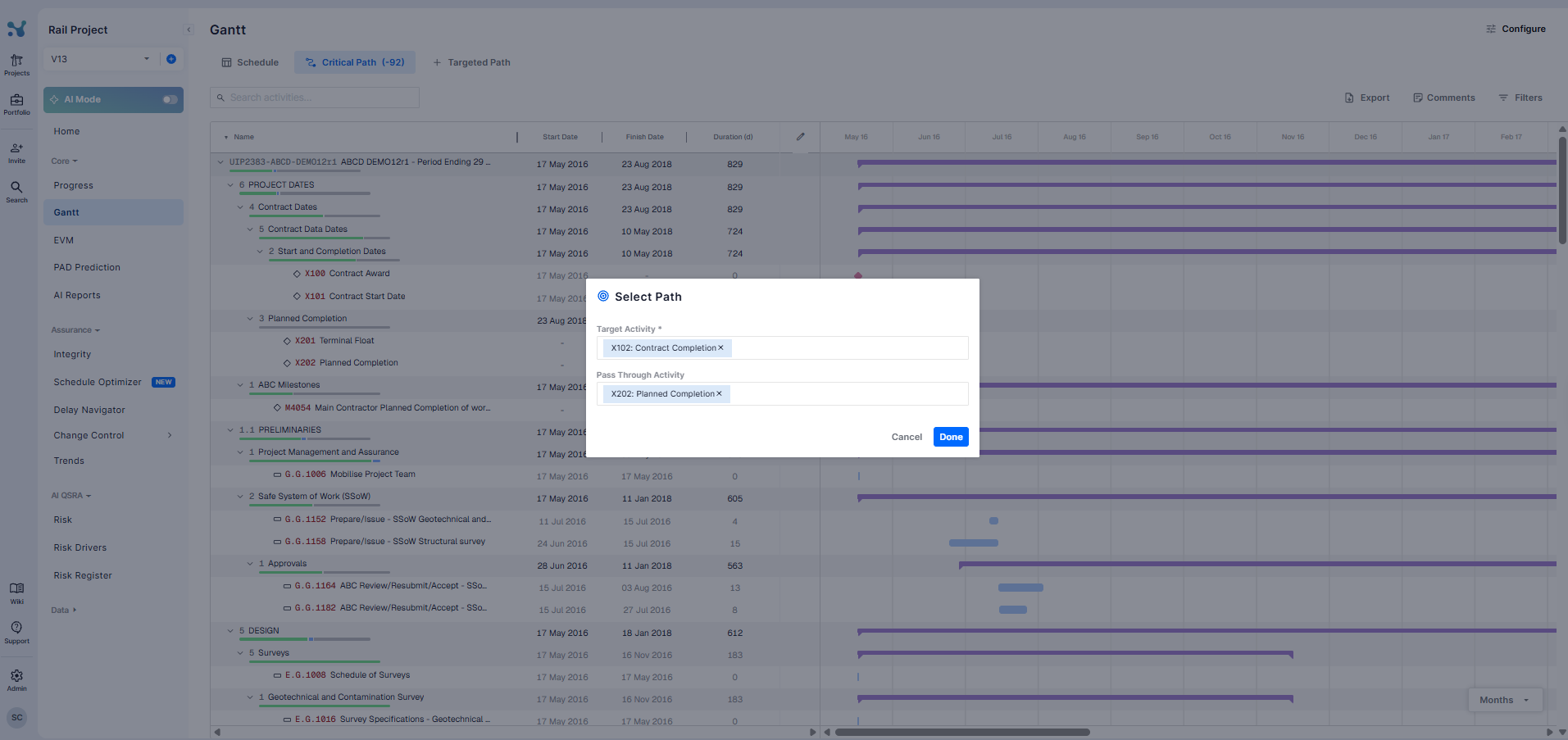
4. Click Done. The Gantt updates to show only the activities on the path to your target.
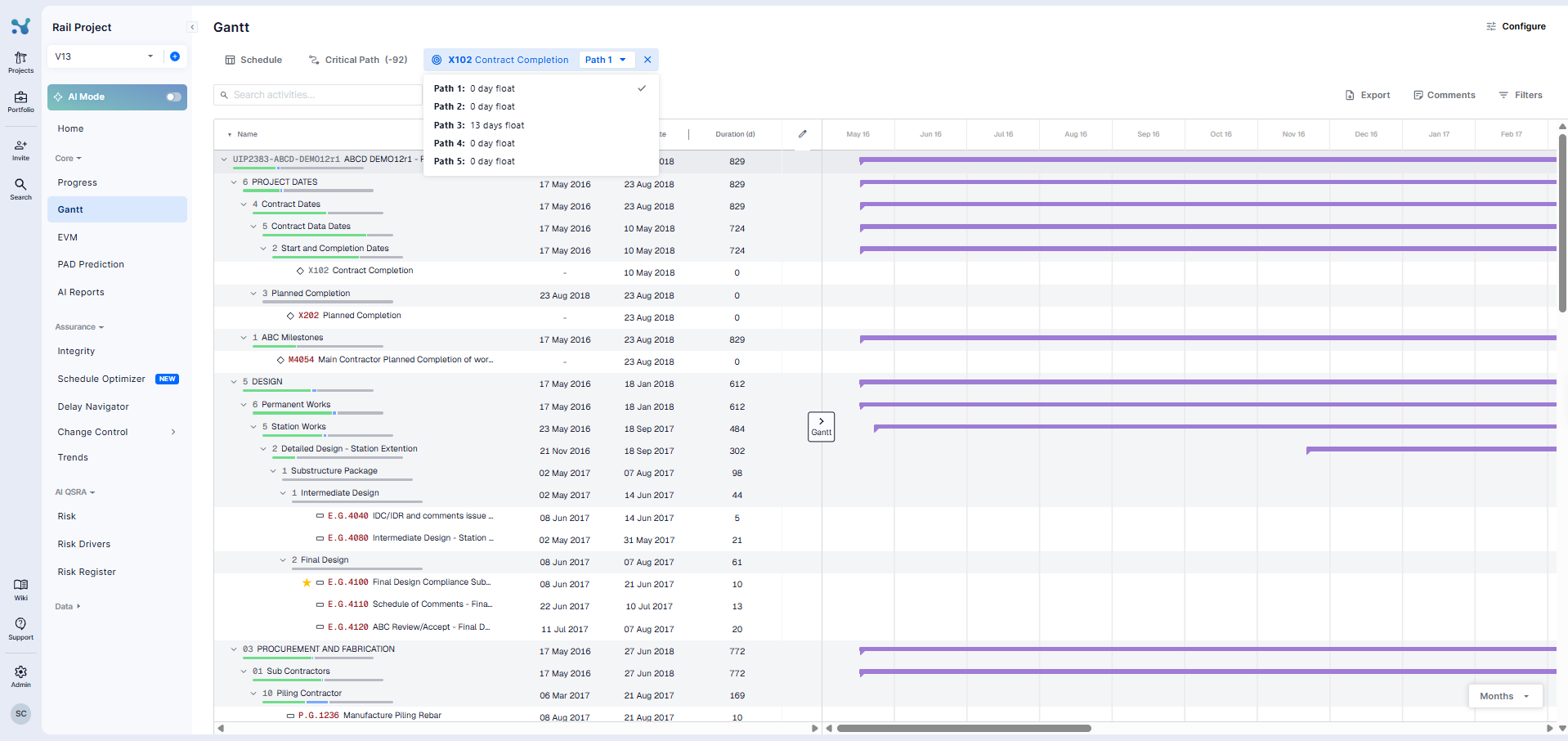
The tab label shows the target activity name. If multiple paths exist, use the Path dropdown on the tab to switch between them — each path shows its float value.
Customize columns
You can tailor the table view to display the information most important to you.
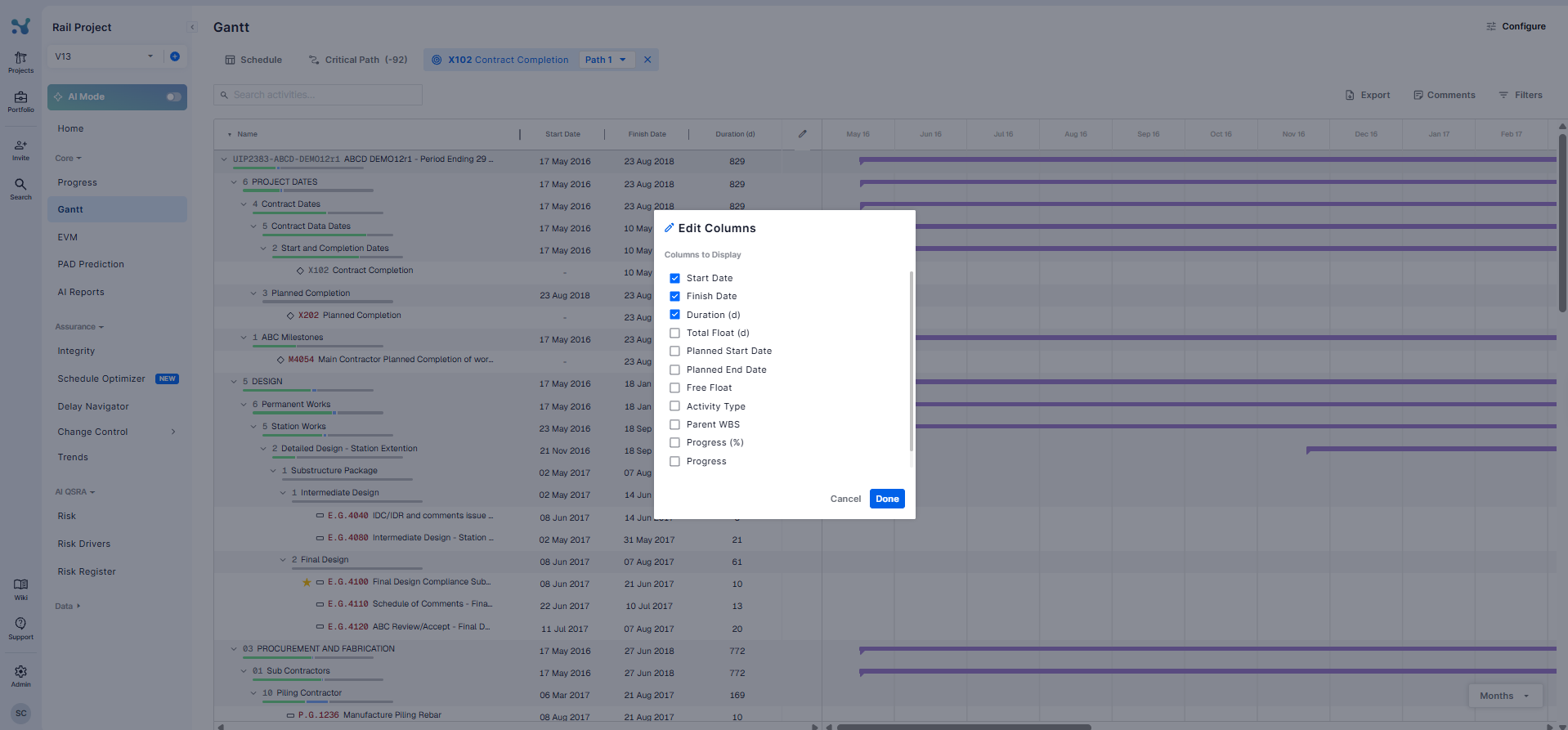
- Click the pencil icon at the top corner of the table to open the column selector.
- From the list, select the columns you want to add, such as progress, free float, planned start and finish dates, total float, activity type, or status.
- To remove columns, simply uncheck them in the selector.
The table will update instantly to show only the columns you selected, helping you focus on the most relevant data.
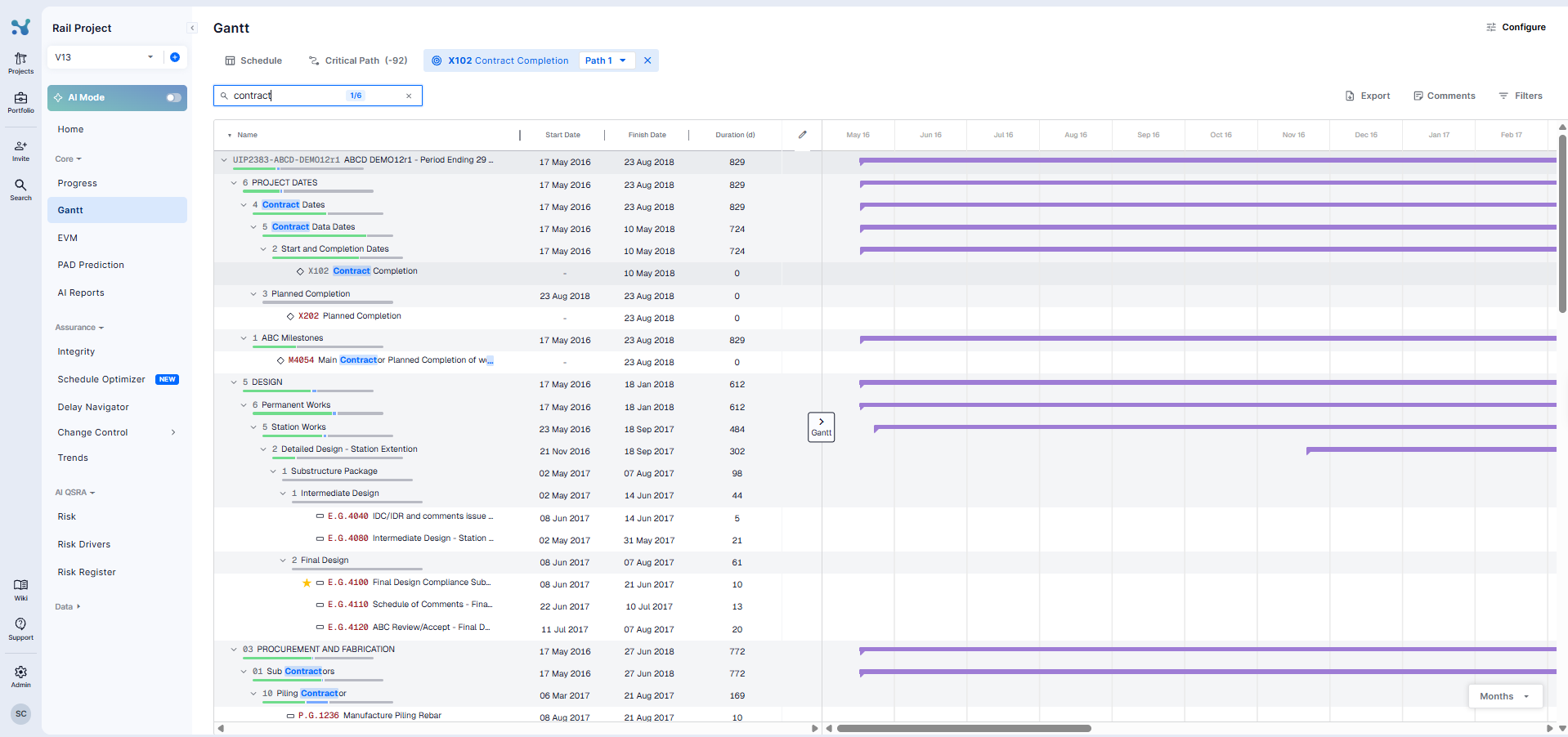
Search activities, WBS, or milestones by name or ID
Use the search bar above the table to quickly find specific activities, WBS elements, or milestones.
Filter activities
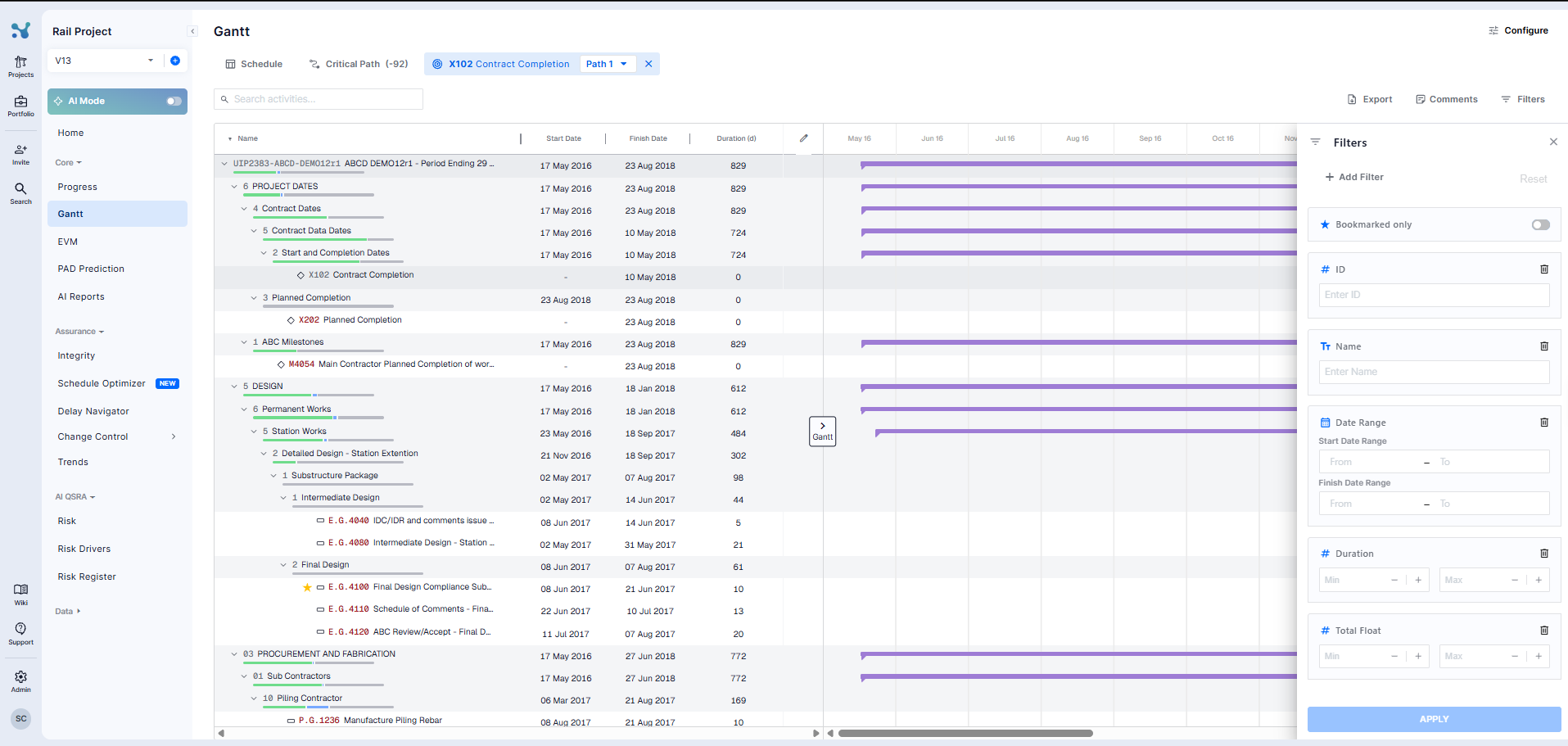
- To open the filters drawer, click the Filters button located above the table.
- Use the filters drawer to refine your view by applying criteria such as:
- Bookmarked Activities
- ID
- Name
- Start date range
- Finish date range
- Duration
- Total float
- To add more filters, click the Add filter button and select from additional options like:
- Activity type
- Planned dates
- WBS/ACS
- Free float
- Status
- Progress
The table updates dynamically to display only rows matching your selected filters.
See activity info
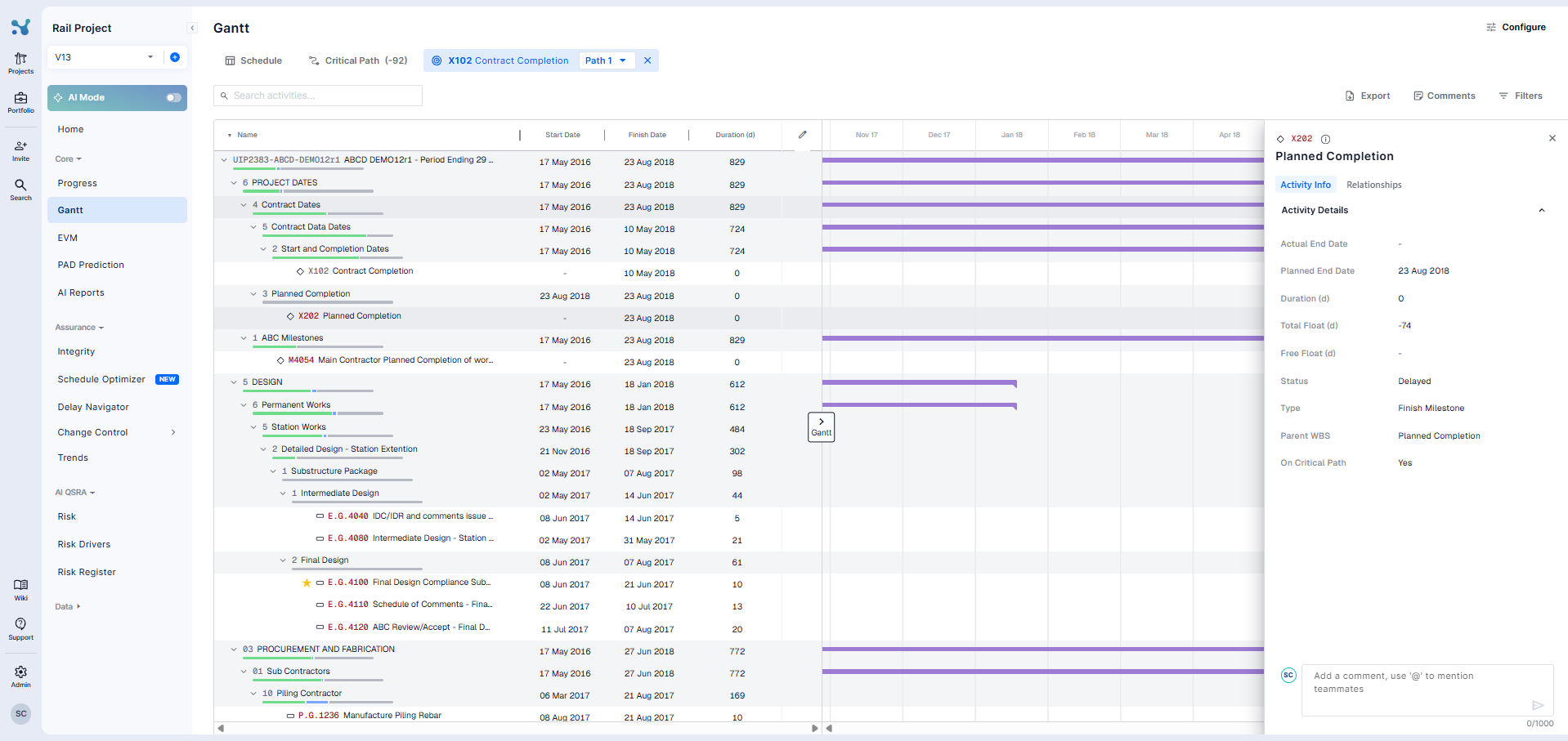
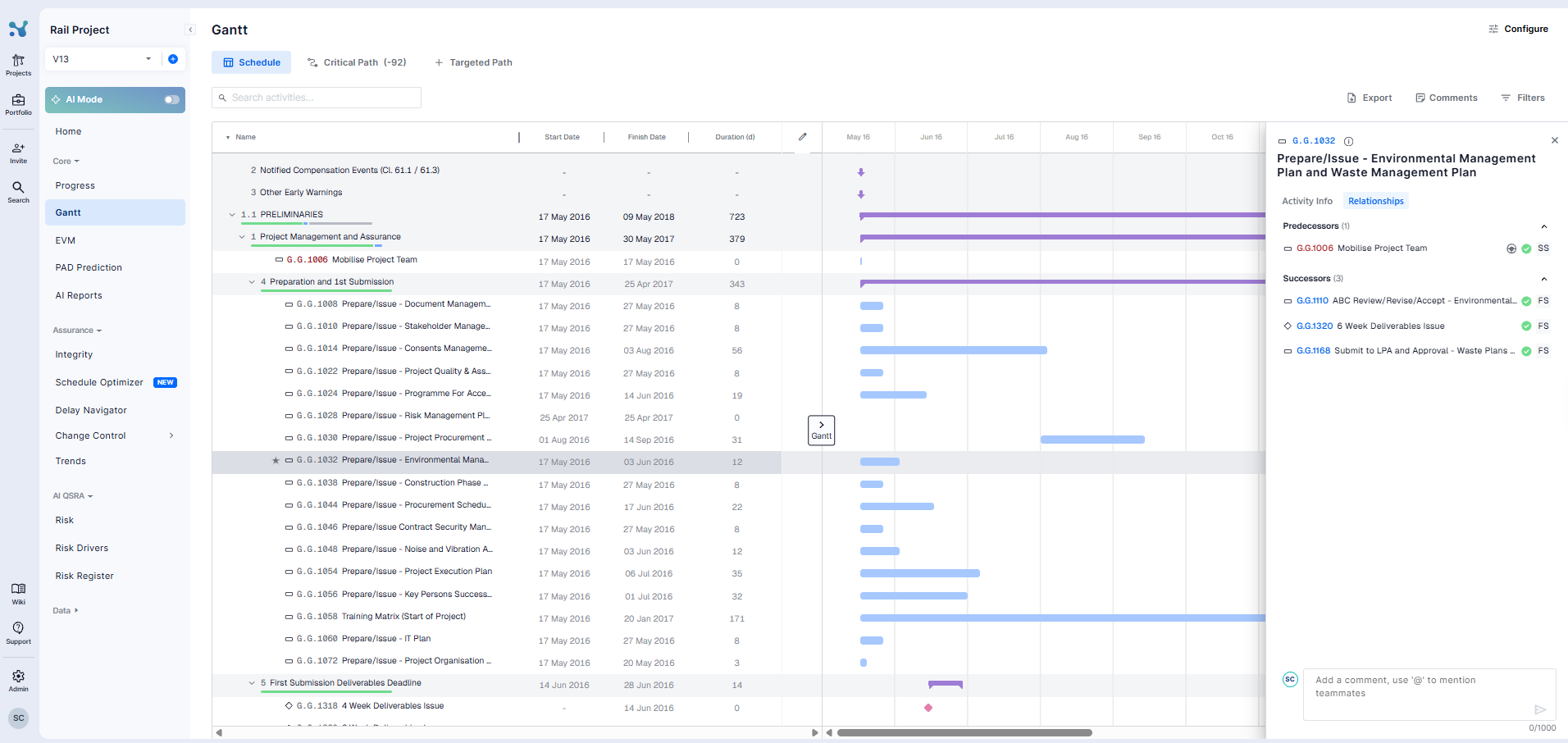
Click on any activity bar, WBS bar, or milestone diamond in the timeline, or on the corresponding row in the table, to open a drawer on the right side of the screen. The drawer has two tabs: Activity Info, which displays detailed information about the selected item such as start and finish dates, duration, type, and critical path status; and Relationships, which lists all predecessors and successors linked to the activity, including their IDs, names, and relationship types. Predecessors marked with a steering wheel icon are driving the selected activity.
Bookmark an actvity
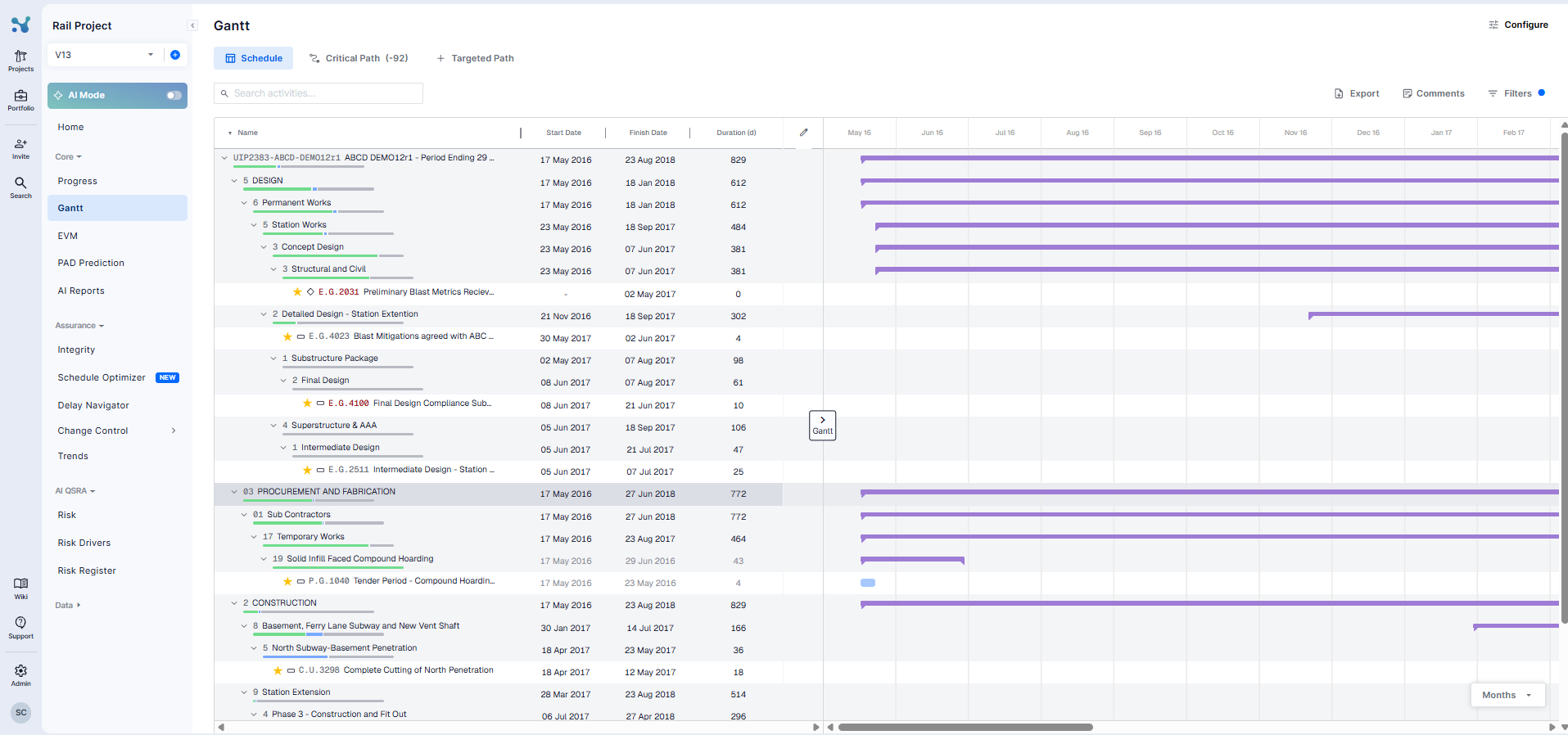
You can bookmark (star) individual activities directly from the Timeline table, then use a dedicated "Bookmarked only" filter to instantly narrow the view down to just your starred activities.
- Hover over/select an activity row in the table - a star icon appears to the left of the row
- Click the star to bookmark the activity. The star fills in solid yellow to indicate it is bookmarked. Click it again to remove the bookmark.
- Open the Filters drawer (Filters button above the table). A "Bookmarked only" toggle appears at the top of the filters list.
- Turn on "Bookmarked only" and click Apply - the table (and Gantt) update to show only bookmarked activities, still nested under their parent WBS/ACS groups for context.
- This filter can be combined with other filters (date range, status, etc.), and toggling it off restores the full list.
Collaborate with your team using comments

Use comments to collaborate with your team on project activities. Share questions, discuss decisions, align on assumptions, and mention colleagues to bring them into the conversation—all without leaving the Timeline view.
- Select a task, WBS, or milestone from the table or timeline.
- A drawer will open on the right side, displaying the details.
- Scroll down to the Comments section at the bottom of the drawer.
- Type your message in the comment box.
- To draw someone's attention, type @ followed by their name to mention a project team member. They will receive an email notification with your comment and a link back to the activity.
- Click the send button to post your comment or type enter
Each comment displays a timestamp and the version of the schedule where it was posted.
Comments persist across schedule updates, remaining linked to the selected activity or WBS and creating a living history of team collaboration. Even as new versions of the schedule are created, previous comments stay visible for reference.
Anyone viewing the schedule can see the discussion, understand the reasoning behind decisions, and add their input. Users can delete their own comments if needed.
View comment activities and unread counts
The Timeline header provides visibility into comment activity directly within the schedule view.
- The Comments button in the header displays the total number of unread comments using a badge.

- The table displays the total number of comments for each WBS and activity.
- A blue comment icon indicates that the item contains unread comments.
- Opening an item’s comments marks them as read and updates your unread counter.

Filter the schedule by commented items
You can filter the Timeline to display only WBS and activities that contain comments.
- Click the Comments button above the table in the header.
- The table updates to show only items with at least one comment.
- Click the Comments button again to remove the filter and return to the full schedule view.
- This filter can be combined with other active filters (such as date, status, or WBS filters).

Zoom in and out
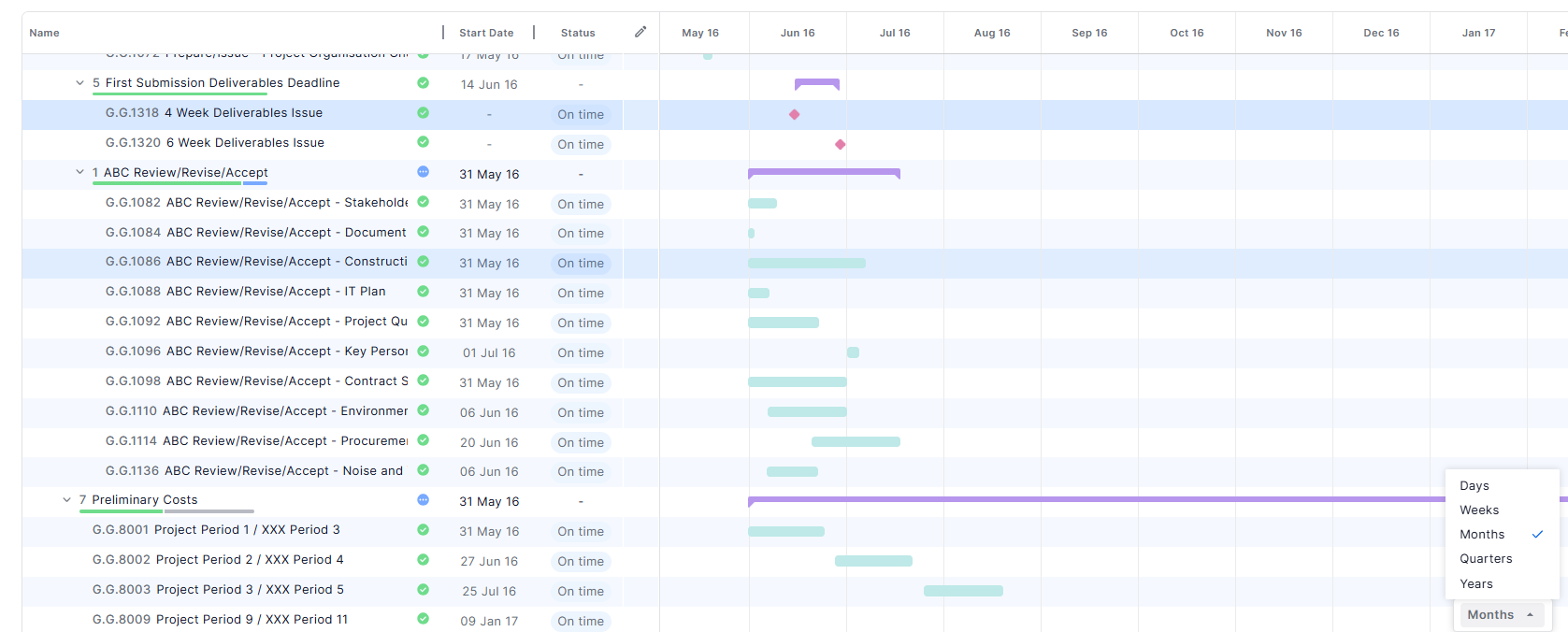
Change the timeline scale to view your schedule by years, quarters, months, weeks, or days using the dropdown at the bottom right corner. This lets you focus on the big picture or drill down into detailed timelines.
Hide/show the Gantt chart panel
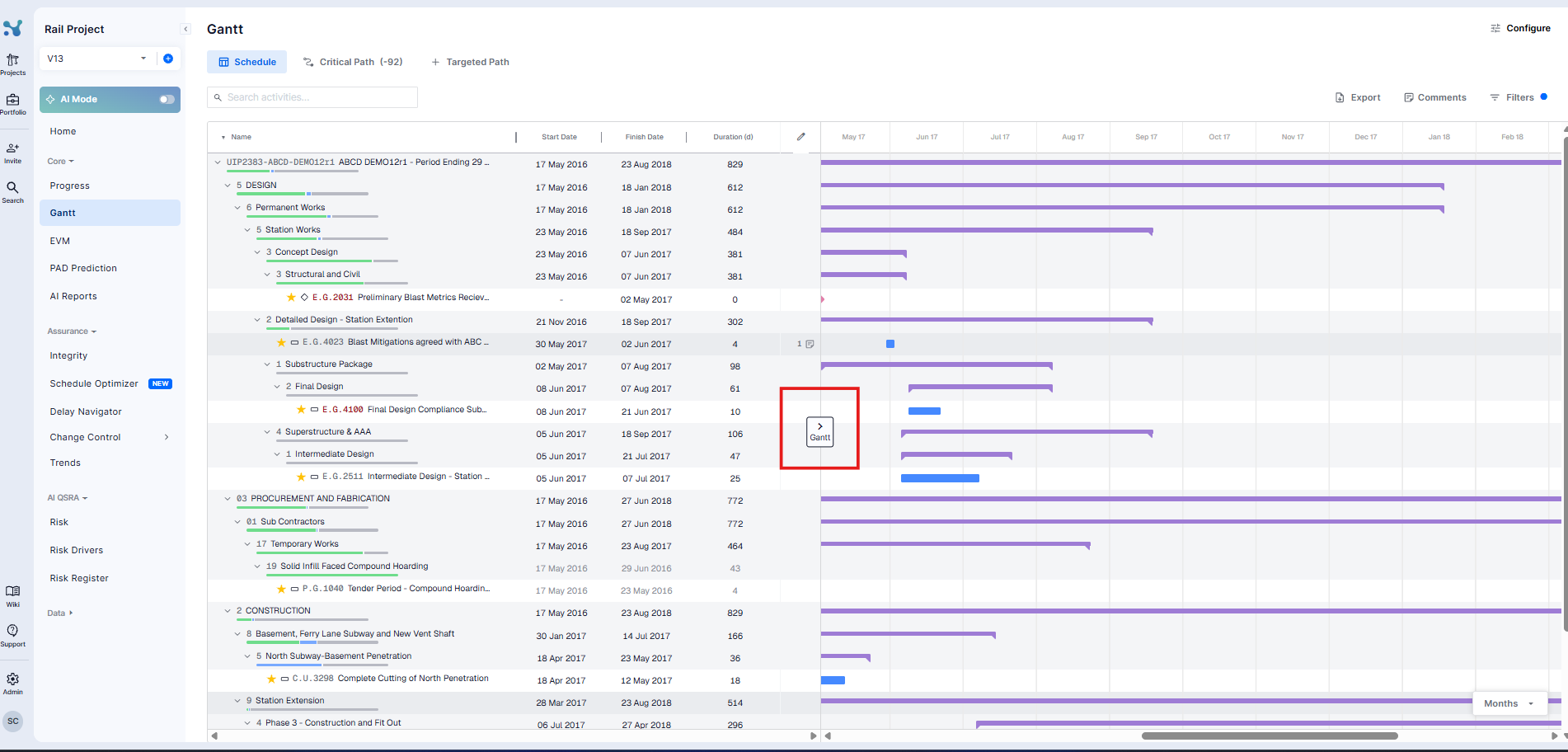
- Locate the small "Gantt" arrow tab on the divider between the table and the Gantt chart
- Click it to collapse the Gantt chart - the table expands to use the freed-up space, useful when you only need to review data columns without the visual timeline.
- Click the arrow again (now pointing the opposite direction) to bring the Gantt chart back.
Go to today’s date
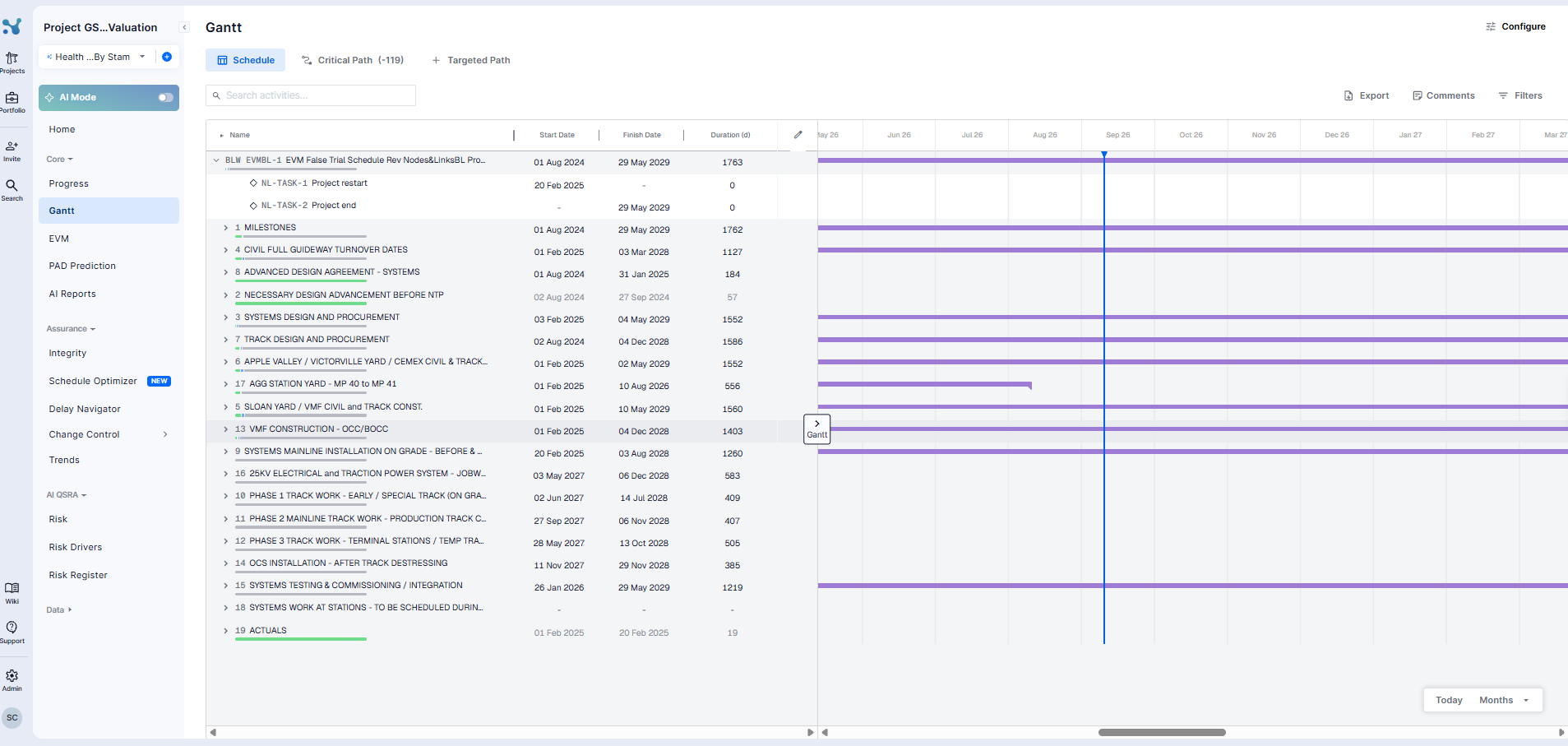
Click the Today button next to the granularity dropdown to instantly scroll the timeline to the current date, helping you quickly find where your project stands now.
Configure timeline display
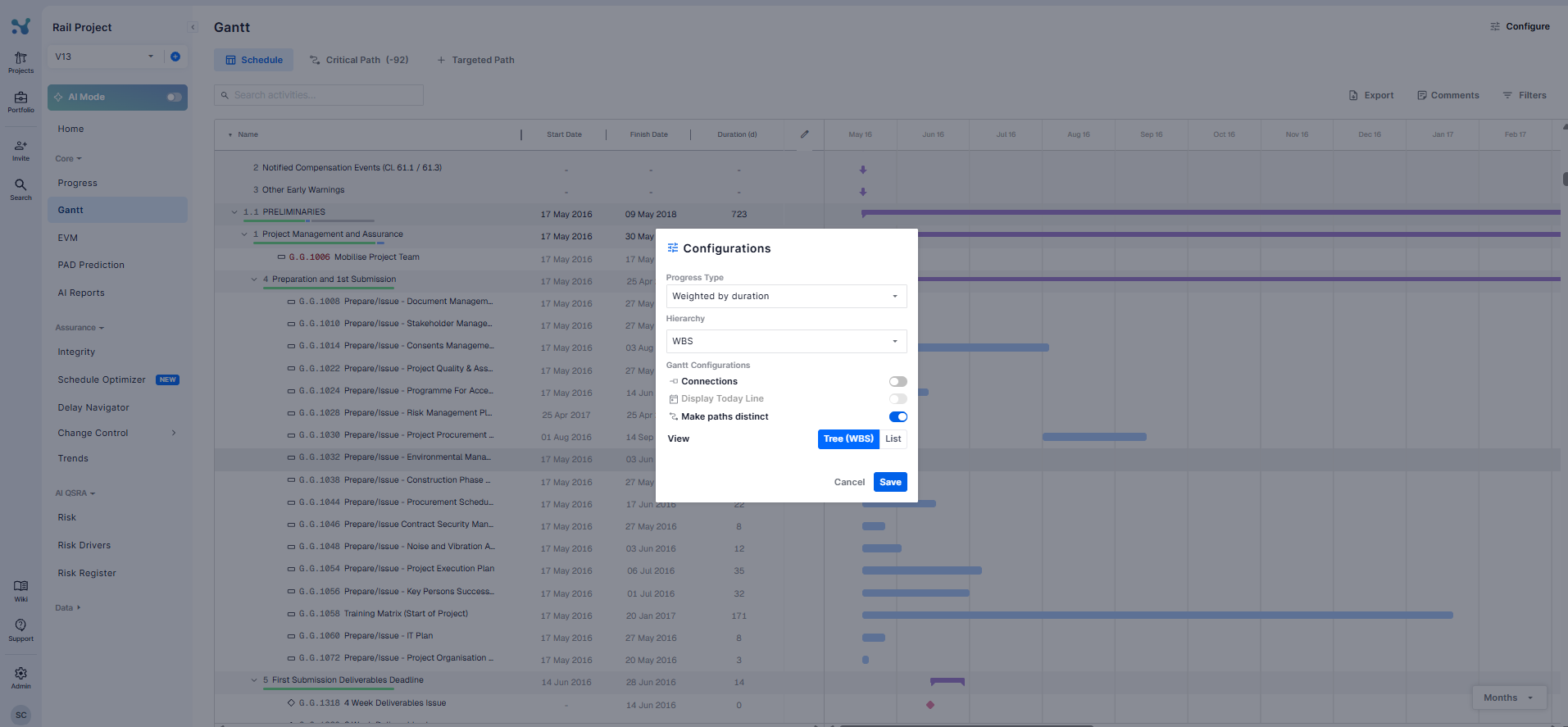
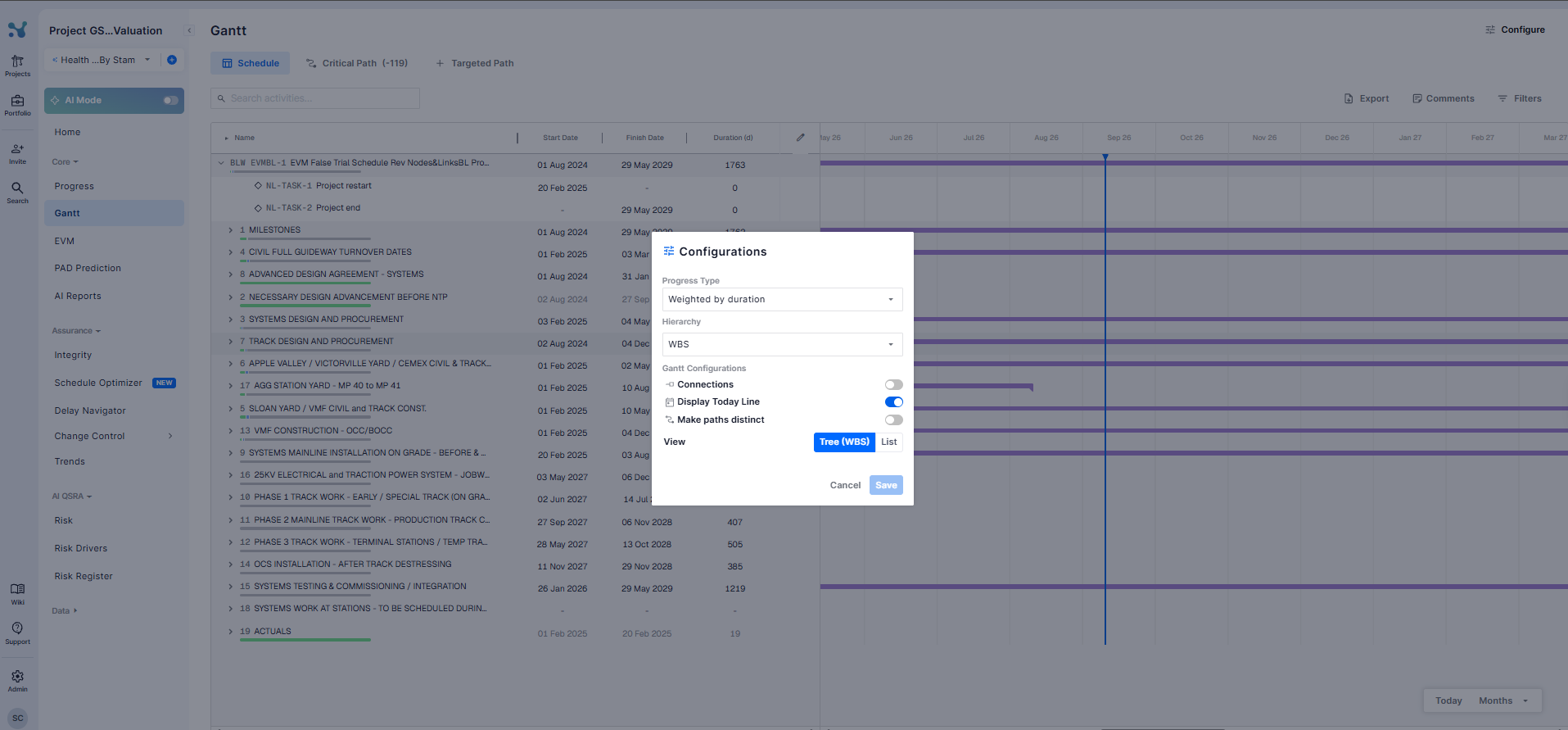
- Open the Configure pop-up from the top right corner to customize timeline settings:
- Choose progress calculation (weighted by duration or activity count)
- Toggle today’s vertical line on or off
- Select the view (Tree or Flat list)
- Enable or disable activity connections
Explore activity connections
When activity connections are enabled, you can visually explore dependencies directly on the timeline. Hover over arrows between activities on the timeline to see relationship types (e.g., finish-to-start) and connected activity details.
When you open the drawer for any activity and switch to the Relationships tab, all listed predecessors and successors are clickable. Clicking any linked activity in the list scrolls the table to that activity’s position in the schedule and highlights its row in blue, making it easy to locate at a glance. The drawer remains anchored to the original activity throughout, so you can step through an entire chain of predecessors and successors one by one without losing your current context. This is especially useful on large schedules where linked activities may be scattered across distant parts of the WBS.
Explore Distinct Paths
The screen includes a "Make paths distinct" toggle in the configuration panel, available when viewing the custom path view. It controls path behavior as follows:
- Off: Paths may share intermediate activities.
- On: Only paths that share no intermediate activities (except the final destination) are returned.
Limit: Up to 5 distinct paths are shown. If fewer than 5 exist, only the available paths are displayed.